
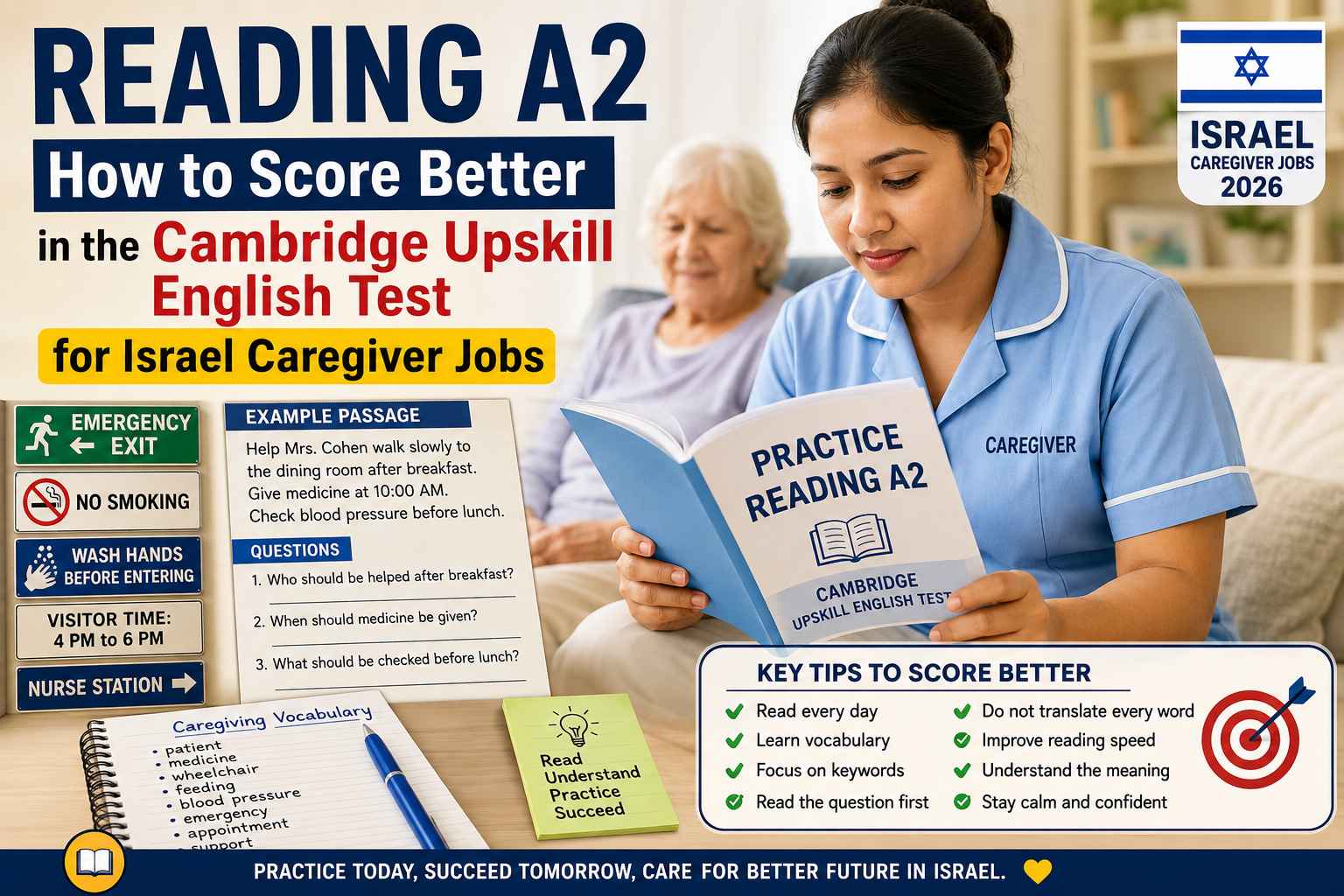
Reading A2 – How to Score Better in the Cambridge Upskill English Test for Israel Caregiver Jobs
For many Nepali applicants applying for Israel caregiver jobs in 2026, the reading section of the Cambridge Upskill English Test feels easier than speaking. However, some candidates still lose marks because they read too slowly, do not understand important vocabulary, or become confused by unfamiliar sentences.
The good news is that Reading A2 level is practical and achievable. In fact, candidates do not need advanced grammar or difficult English literature. Instead, the test mainly checks whether applicants can read and understand simple English used in everyday life and caregiving work.
Because caregivers in Israel must read instructions carefully and understand information correctly, reading is an important part of the selection process. Therefore, preparing for Reading A2 can improve both your test performance and your future work confidence.
What Does A2 Reading Level Mean?
At A2 reading level, candidates should understand short and simple English used in common situations.
In other words, applicants should be able to:
- read short messages
- understand hospital notices
- follow daily schedules
- read simple instructions
- understand workplace signs
- identify basic healthcare-related information
- recognize important caregiving vocabulary
The exam usually focuses on practical understanding. Therefore, candidates must read carefully and choose correct answers based on meaning.
For example, you may see short notices, signs, instructions, or small reading passages.
Common Reading Examples in the Cambridge Upskill Test
1. Medicine Instructions
Caregivers often help elderly patients with medicine. Because of that, medicine-related reading is very common.
Example:
Take one tablet after breakfast and one tablet before bedtime.
Question:
How many tablets should the patient take in one day?
Answer:
Two tablets
Another example:
Please do not give medicine on an empty stomach.
Meaning:
The patient should eat food first.
Important words:
- tablet
- medicine
- breakfast
- after meal
- before bedtime
- dosage
- prescription
Therefore, learning medicine vocabulary helps a lot.
2. Hospital Signs and Room Notices
In hospitals or care homes, caregivers read signs every day.
Examples:
Emergency Exit
No Smoking
Wash Hands Before Entering
Visitor Time: 4 PM to 6 PM
Nurse Station
Keep the Door Closed
Possible question:
What time may visitors come?
Answer:
From 4 PM to 6 PM
Meanwhile, signs often use short English. So candidates should practice understanding quickly.

3. Patient Care Instructions
This type is very important for Israel caregiver jobs.
Example:
Help Mrs. Cohen walk slowly to the dining room after breakfast. Give medicine at 10:00 AM. Check blood pressure before lunch.
Questions may include:
Who should be helped after breakfast?
When should medicine be given?
What should be checked before lunch?
Answers:
Mrs. Cohen
10:00 AM
Blood pressure
As a result, candidates need both reading accuracy and attention to detail.
4. Daily Work Schedules
Caregivers usually follow schedules.
Example:
| Time | Task |
|---|---|
| 7:00 AM | Wake patient |
| 8:00 AM | Breakfast |
| 10:00 AM | Medicine |
| 1:00 PM | Lunch |
| 4:00 PM | Walking exercise |
| 8:00 PM | Dinner |
Possible questions:
When is lunch?
When should medicine be given?
This section becomes easier with regular practice.
5. Visitor Notices
Example:
Family members may visit patients only between 5 PM and 7 PM. Please keep noise low.
Questions:
Who may visit?
When can they visit?
What should visitors do?
Therefore, candidates should read carefully and avoid rushing.
Why Nepali Applicants Sometimes Struggle in Reading
Even simple reading can feel difficult for several reasons.
For example:
Unfamiliar vocabulary
Candidates may understand most words but stop because of one difficult word.
Reading too slowly
Some applicants understand English but spend too much time.
Translating every word into Nepali
This wastes time.
Nervousness during the exam
Stress can reduce focus.
Skipping key details
Sometimes one word changes the whole meaning.
However, these problems improve with daily reading.
Best Daily Reading Practice for Nepali Applicants
A simple routine works best.
Morning – 10 minutes
Read short English news.
Choose easy topics.
Examples:
- health
- travel
- daily life
Focus on meaning.
Afternoon – 10 minutes
Practice caregiving vocabulary.
Example words:
- elderly
- patient
- wheelchair
- feeding
- bathing
- appointment
- medicine
- pain
- nurse
- doctor
- blood pressure
- emergency
- hospital
- support
Then make sentences.
Example:
“The patient needs medicine.”
“The nurse checked blood pressure.”
Evening – 15 minutes
Read aloud.
This improves:
- reading speed
- pronunciation
- confidence
- vocabulary memory
In addition, reading aloud helps with speaking.
How to Read Faster in the Exam
Speed matters.
Here are useful tips:
First read the question
Then read the passage.
Because of this, your mind looks for the correct answer quickly.
Focus on keywords
Example:
medicine
time
patient name
warning
instruction
Do not stop for every difficult word
Try understanding from the sentence.
Example:
“Please assist the patient carefully while walking.”
Even if “assist” feels new, you can guess it means “help.”
Underline important words during practice
This trains your eyes.
Practice every day
Regular practice improves speed naturally.
Vocabulary Practice Example
Word: wheelchair
Sentence:
“The patient uses a wheelchair.”
Word: feeding
Sentence:
“I help with feeding.”
Word: appointment
Sentence:
“The doctor appointment is tomorrow.”
Word: emergency
Sentence:
“Call the nurse in an emergency.”
Word: pain
Sentence:
“The patient has pain in the leg.”
The more caregiving vocabulary you know, the easier reading becomes.
Practice Questions for Reading A2
Example 1
Please give the patient warm water after dinner.
Question:
When should warm water be given?
Answer:
After dinner
Example 2
Visitors are not allowed after 7 PM.
Question:
Can visitors come at 8 PM?
Answer:
No
Example 3
The patient should take medicine before breakfast.
Question:
When should medicine be taken?
Answer:
Before breakfast
Example 4
Please help Mr. David walk to the garden at 5 PM.
Question:
Where should Mr. David go?
Answer:
Garden
Final Reading Tips for Cambridge Upskill English Test
Before exam day remember these:
✅ Read every day
✅ Learn caregiving vocabulary
✅ Practice short passages
✅ Read aloud
✅ Improve speed
✅ Focus on keywords
✅ Understand meaning
✅ Stay calm during the test
Most importantly, do not worry about perfect English.
The Cambridge Upskill English Test for Israel caregiver jobs checks practical understanding. Therefore, candidates who practice regularly can improve step by step.
Even 20–30 minutes of daily reading practice can make a big difference.
With strong preparation, better vocabulary, and regular practice, Nepali applicants can score better in Reading A2 and move one step closer to working in Israel as a caregiver.