
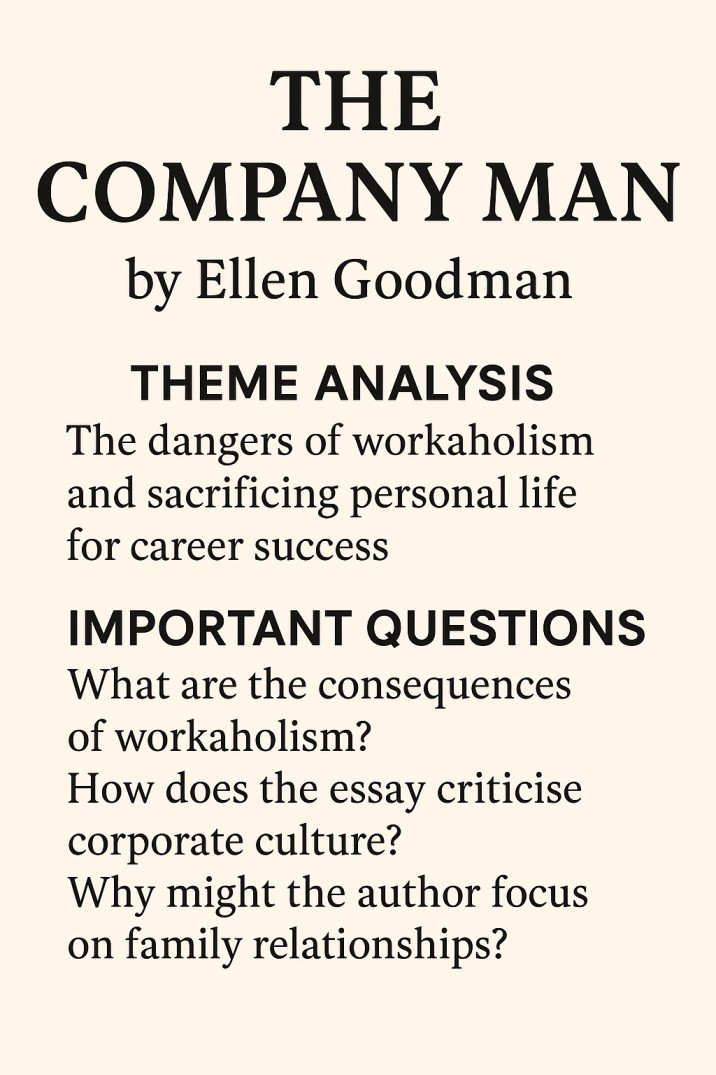
The Company Man by Ellen Goodman
Long Summary, Theme, and Questions
Long Summary
Ellen Goodman’s essay The Company Man tells the tragic story of Phil, a 51-year-old vice president in a company. He works day and night, six days a week, and never allows himself to rest. Even on Saturdays, he goes to the office, only changing his formal suit for a sports jacket to remind himself that it is the weekend.
Phil lives a routine life without hobbies or relaxation. He eats the same lunch—egg salad sandwiches at his desk—every single day. He is overweight and nervous, yet he convinces himself that not smoking makes him healthy enough. Although the company has reduced the workweek for most employees, Phil continues to work long hours like the “important people” at the top. He dreams of reaching the highest position if the president retires early enough.
At home, his family feels abandoned. His wife Helen once competed with his job for his attention, but she gave up years ago. She admits she has already missed him long before his death. His eldest son, a hardworking executive, hardly knows him. Before the funeral, this son asks neighbors what his father was really like because he never had a personal connection. His daughter feels close to her mother but has nothing to say to her father when they are alone. His youngest son, who does odd jobs, is the only one who tries to pull Phil back into the family. He once remarks, “My father and I only board here,” showing how little Phil belongs at home.
On a Sunday morning at 3 a.m., Phil suffers a fatal heart attack. No one feels surprised because everyone had seen the warning signs for years. At the funeral, the company president praises Phil’s work but, by the afternoon, quietly begins looking for his replacement. This cold response proves how little the company values loyalty and sacrifice. Goodman uses Phil’s life and death as a warning against workaholism and blind devotion to corporate culture.
Theme Analysis
Goodman presents workaholism as destructive. Phil sacrifices health, family, and happiness, yet the company views him as replaceable. The essay criticizes corporate culture, where profit matters more than people. At the same time, it highlights the importance of family values, showing how neglect leaves behind emptiness. Finally, Goodman reveals the irony of success: chasing professional achievement without balance can lead only to regret.
Solved Questions
Content Questions
1. What are the characteristics of the company man besides being a workaholic?
He works nonstop, ignores his health, has no hobbies, and neglects his family. He also believes his value comes only from his job.
2. Explain Phil’s relationship with his younger son. How is it different from the relationship with his other children?
Phil’s younger son tries to connect with him and becomes his favorite. However, his older children grow up distant, with almost no bond. Goodman highlights this difference to show how Phil had one last chance for a real connection, but work still stood in the way.
3. What does the description of Phil’s wife and children add to the meaning of “company man”?
It shows the personal cost of being a company man. His wife feels abandoned, and his children hardly know him. This proves that excessive work destroys family life.
4. In what ways does the essay criticize corporate America?
It shows that companies push people to sacrifice everything for work, yet replace them instantly after death. Corporate America values productivity but ignores humanity.
5. What is the irony in saying, “You could have picked Phil out in a minute from a lineup”?
It means Phil lived such a predictable life as a stressed, overworked man that anyone could easily spot him as a heart attack victim. His fate was obvious, but he still ignored it.
6. What do we infer from the author saying Phil “worked like the Important People”?
Phil copied the habits of top executives, thinking it made him important. Yet the company treated him as disposable, showing he was never truly valued.
7. Why does Goodman emphasize that Phil died at 3 a.m. on Sunday?
It highlights the ultimate irony. Even on his day off, he could not escape the stress of work. His death at that hour proves that work consumed his life completely.
Strategy and Style Questions
1. Discuss Goodman’s voice in this essay. Is it ironic, sarcastic, or neutral?
Her voice is ironic and critical. She uses sarcasm to expose the emptiness of Phil’s life and the coldness of corporate culture.
2. What does the author think of Phil? Is her tone appropriate?
She feels pity for him but criticizes his blind devotion to work. The tone is appropriate because it warns readers about the dangers of workaholism.
3. Does Goodman develop all characters in enough detail?
Yes. She describes the wife’s bitterness, the children’s distance, and the company’s indifference, making the message powerful.
4. How does the author prepare us for the conclusion? Does it make it more effective?
She repeatedly describes Phil’s overwork, poor health, and family neglect. So, when the company quickly looks for a replacement, the ending feels sharp and painfully ironic.
Read More: Advertise Your Business: BBS Second English: Summary and Theme
https://yourallnotes.com/advertise-your-business-bbs-second-english/#google_vignette